parkerpens.net / parkercollector.com [source]
Parker · 1956-1983
Parker 61
What to Look For
The capillary filling system can clog with dried ink. Clean thoroughly. Mark I (capillary, 1956-69) vs Mark II (cartridge/converter, 1969-83).
The Parker 61 introduced one of the most innovative — and finicky — filling systems in fountain pen history: capillary filling.1
Capillary Filling (Mark I, 1956-1969)
The original Parker 61 had no visible filling mechanism. Simply unscrew the barrel, dip it in ink, and capillary action draws ink into a specially treated core inside the pen.1 It was elegant in theory but could clog with dried ink if neglected. Clean thoroughly and use regularly.2
Cartridge/Converter (Mark II, 1969-1983)
Acknowledging the capillary system’s limitations, Parker switched to a conventional cartridge/converter system in 1969 while keeping the 61’s distinctive streamlined design.1
Significance
The 61 represents Parker’s willingness to take engineering risks. The capillary system was a genuine innovation — no plunger, no lever, no squeeze bar — but proved too temperamental for mass-market reliability. The Mark II gracefully acknowledged this while preserving the pen’s aesthetic.1
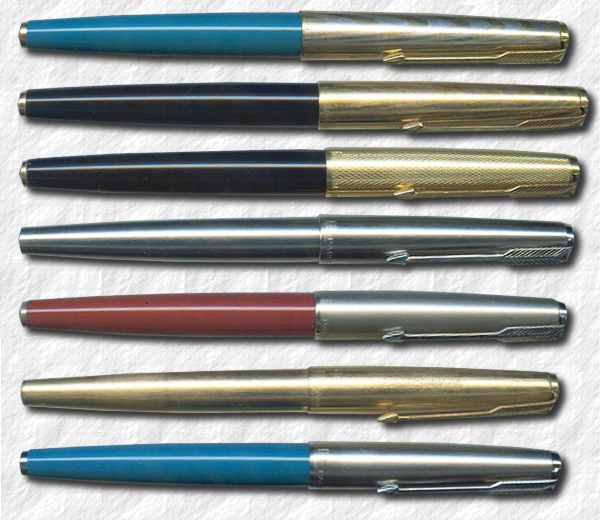
The Sachs-Fultz Collection holds an extraordinary range of Parker 61s including Rainbow Cap variants in multiple colors, 18K gold cap and barrel versions, 9K English gold versions, and multiple prototypes.3