

Waterman · 1935-1941
Waterman Ink-Vue
What to Look For
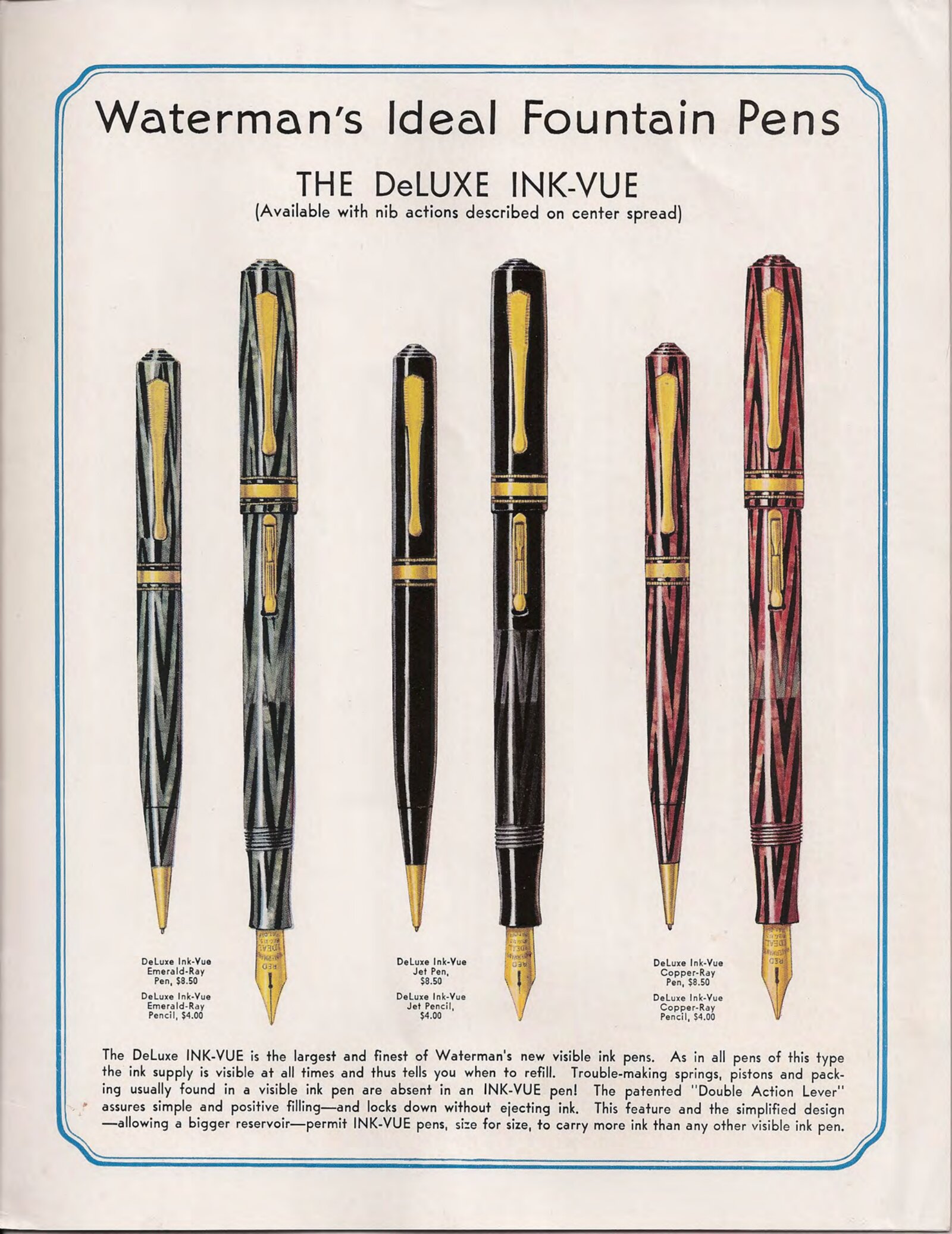
Strongly Art Deco with bold zigzag pearlescent celluloid. Early pens (Dec 1935) have one-piece lever (gone by June 1936). Look for Waterman globe emblems on metal disks at cap top and barrel end. DeLuxe has triple cap band and #7 nib. The 5116 (1939) has one-piece barrel with screw-in plug. Demonstrators in transparent celluloid exist.
The Waterman Ink-Vue was Waterman’s response to Parker’s Vacumatic — a visible-ink-supply pen with a bold Art Deco design, introduced in September 1935.1
Design
The Ink-Vue features a “strongly Deco” design with a bold zigzag pattern of pearlescent celluloid.1 Unlike the Parker Vacumatic’s subtle laminated stripes, the Ink-Vue made its transparent barrel a dramatic design statement. The filling system uses “a bulb-filler with a mechanically-squeezed bulb” — a lever compresses an internal rubber bulb to draw ink.1
Models
The 1936 Waterman catalog lists four Ink-Vue models:2
| Model | Size | Nib | Price | Notes |
|---|---|---|---|---|
| DeLuxe | Large | #7 | $8.50 | Triple cap band, milled side bands, stepped ends1 |
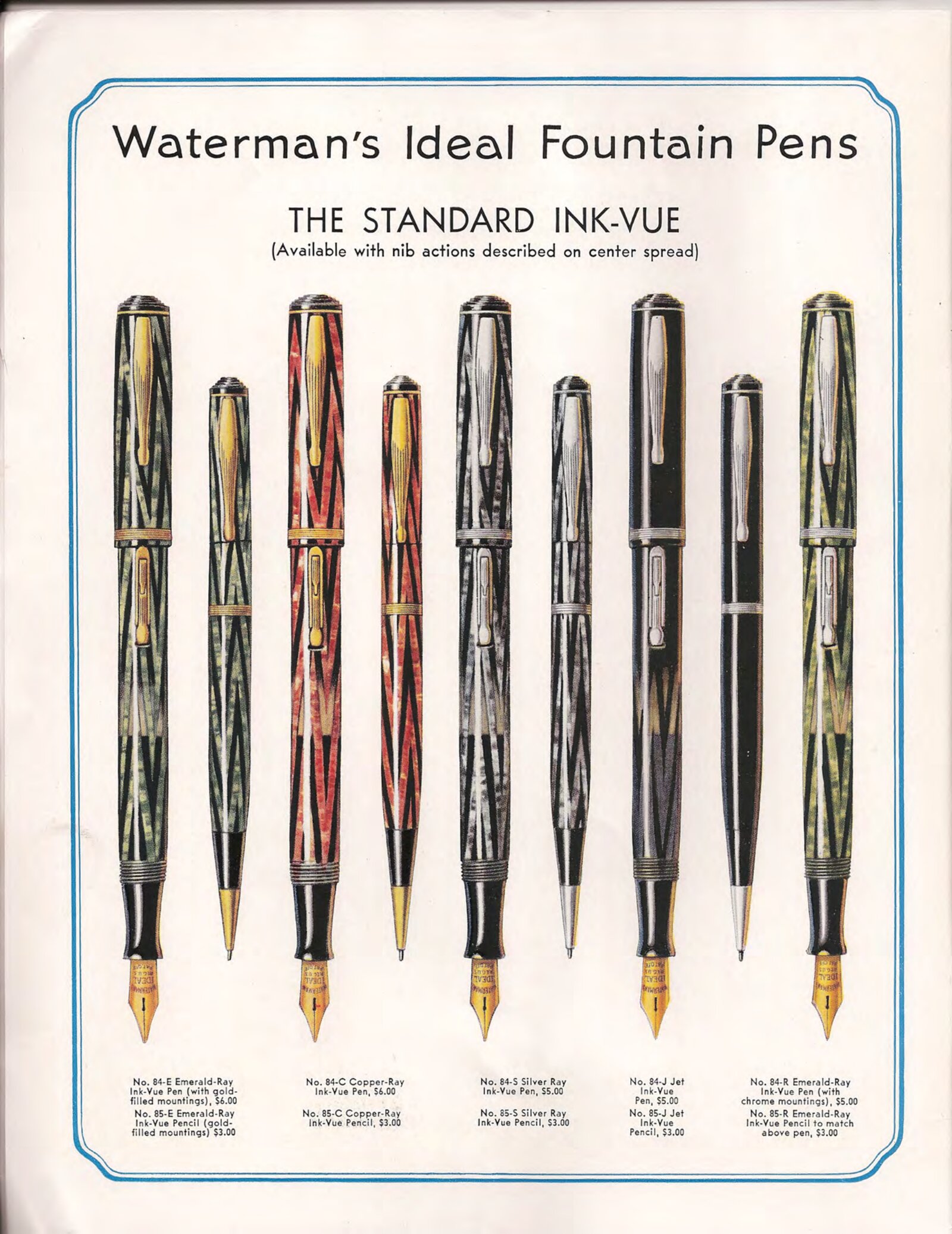
| Standard (No. 84) | Standard | #5 | $5-6 | Most common. Available with gold-filled ($6) or chrome ($5) mountings2 |
| Lady Patricia Ink-Vue | Ladies | Small | $5 | Scaled-down with patterned ink window. “The most popular Ink-Vue model of all”1 |
| 5116 (1939) | Standard | Standard | — | One-piece barrel with screw-in plug system and flanged rubber bulb1 |
Colors
The DeLuxe was offered in Emerald-Ray (green), Jet (black), and Copper-Ray, all at $8.50.2 The Standard No. 84 came in five colors: Emerald-Ray, Copper-Ray, Silver Ray (grey), Jet, and Emerald-Ray with chrome mountings.2 Lady Patricia Ink-Vue variants included Black Lace, Sunset (red pearl), and Mist (grey pearl) at $5.2
Identification
Early pens (December 1935) have a one-piece lever — gone by June 1936, replaced by a jointed two-piece lever.1 Look for Waterman globe emblems on metal disks at the cap top and barrel end.1 DeLuxe models have milled side bands and a matching clip.1 Demonstrators in fully transparent celluloid were produced after 1936.1
History
The Ink-Vue was introduced as Parker’s Vacumatic was dominating the visible-ink market.3 It was a strong design but arrived late — Parker had a two-year head start. By 1941, the Ink-Vue line was discontinued as Waterman struggled against Parker’s momentum.3
-
David Nishimura, “Waterman Ink-Vue,” vintagepens.com. Link. ↩ ↩2 ↩3 ↩4 ↩5 ↩6 ↩7 ↩8 ↩9 ↩10
-
Waterman’s Ideal Fountain Pen catalog, 1936, pp. 3-5 (DeLuxe Ink-Vue, Standard Ink-Vue, Lady Patricia). Internet Archive. Link. ↩ ↩2 ↩3 ↩4 ↩5
-
Dirck de Lint, “Waterman Family Album,” Ravens March Fountain Pens. Link. ↩ ↩2