Waterman · 1929-1934
Waterman Patrician
What to Look For
Relatively rare and valuable. Check celluloid for cracks, especially around lever slot. The Keyhole nib is distinctive and writes beautifully.
The Waterman Patrician is Waterman’s first celluloid fountain pen and their most prestigious model of the early 1930s — a large, colorful pen in striking Art Deco colors, introduced in 1929 as a direct response to Parker’s Duofold.1
History
By the late 1920s, Waterman was losing ground to Parker, whose colorful Duofold had proven that customers would pay premium prices for pens that weren’t plain black.1 The Patrician was Waterman’s belated answer — their first pen in celluloid rather than the traditional hard rubber.1 Introduced in 1929, it was priced at $10 (roughly $175 in today’s money).2 Unfortunately, the timing was catastrophic: the Great Depression hit weeks after its launch, and few customers could justify a luxury pen purchase.1 Limited sales during the Depression make surviving Patricians rare and valuable today.1
Design & Construction
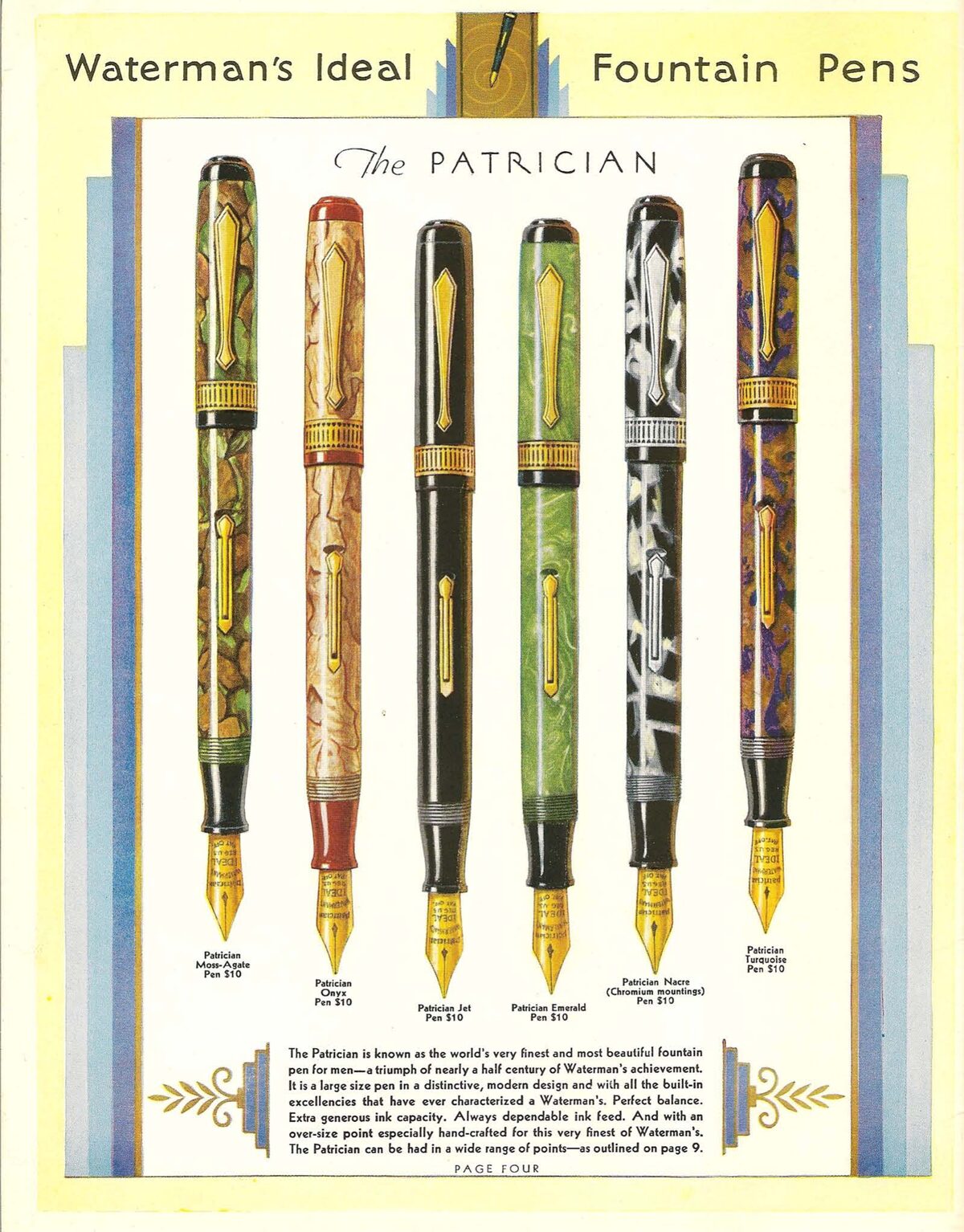
The Patrician is a large pen with a distinctive, modern profile and a lever-filling mechanism.2 The 1933 Waterman catalog calls it “the world’s very finest and most beautiful fountain pen for men — a triumph of nearly a half century of Waterman’s achievement.”2 It features an over-size point “especially hand-crafted for this very finest of Waterman’s.”2
The pen’s most distinctive feature is the Keyhole nib — named for its keyhole-shaped breather hole — which writes beautifully with a wet, smooth line.3
Colors
The 1933 catalog shows six colors, all priced at $10:2
- Moss Agate — green and brown swirled celluloid (gold-filled mountings)
- Onyx — black with red veining (gold-filled mountings)
- Jet — solid black (chromium mountings)
- Emerald — translucent green (gold-filled mountings)
- Nacre — pearl/grey with black marbling (chromium mountings)
- Turquoise — blue with multicolored flecks (gold-filled mountings)
Of these, Turquoise and Emerald are the most sought-after by collectors.4
Lady Patricia
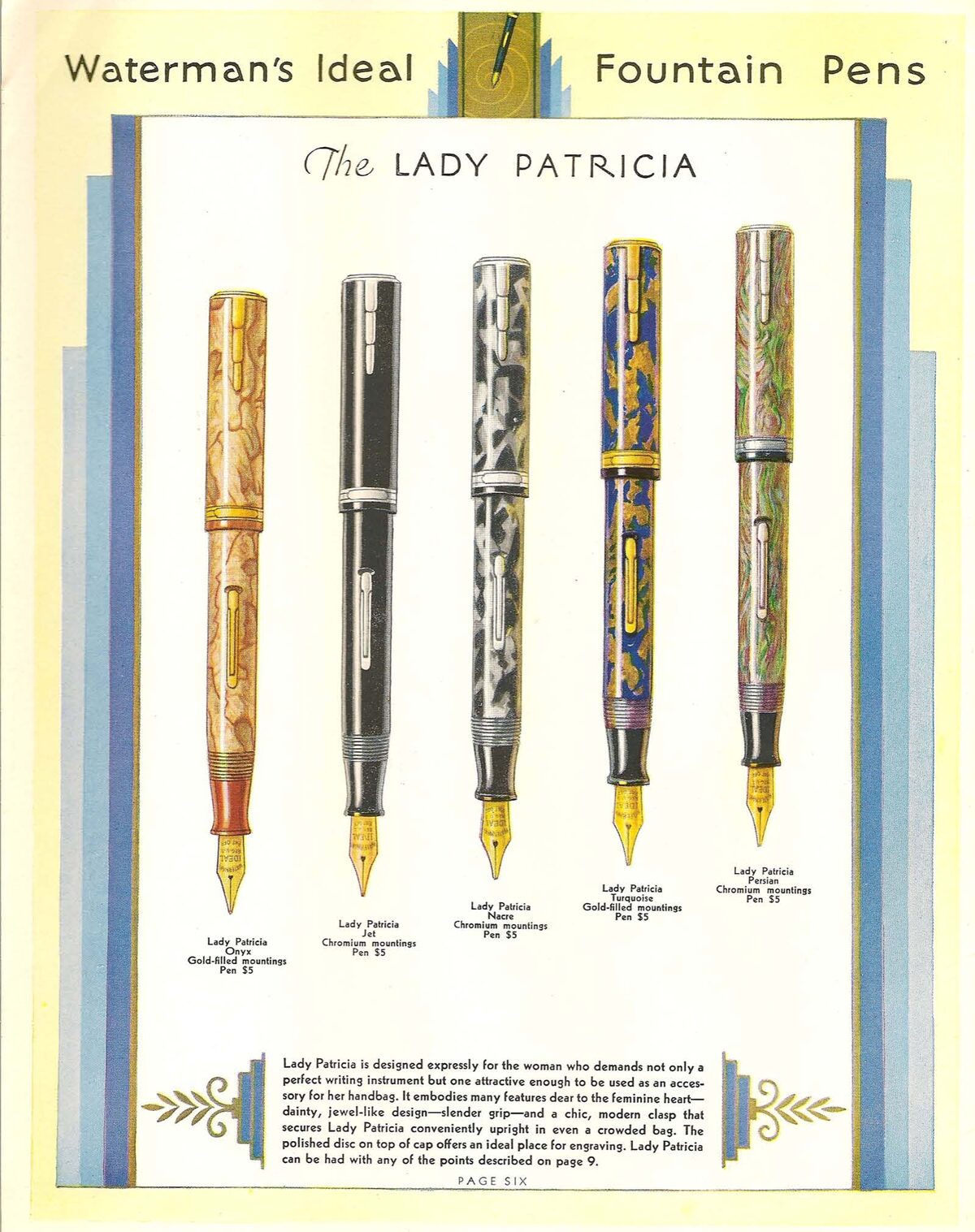
The Lady Patricia was the smaller companion pen, designed for women at $5.2 The 1933 catalog describes it as “designed expressly for the woman who demands not only a perfect writing instrument but one attractive enough to be used as an accessory for her handbag.”2 Available in the same six colors as the Patrician, with the addition of Persian (blue/yellow/green mosaic pattern).2 By 1936, Lady Patricia Ink-Vue variants were offered in Black Lace, Sunset, and Mist patterns at $5.5
Identification
Look for celluloid construction in one of the six Patrician colors.3 Check the lever slot area for cracks — celluloid is prone to cracking there.6 The Keyhole nib is distinctive and should be marked “Waterman’s Ideal.”3 Due to the Patrician’s value, reproductions exist — verify the celluloid pattern, nib markings, and barrel imprint carefully.
Market Value
Patricians currently sell for between $300 and $1,500+ depending on color and condition.7 Exceptional examples in rare colors (Turquoise, Emerald) that are not discolored can command even higher prices.7 The pen’s short production run (1929-1934), premium positioning, and Depression-era timing conspire to make it one of the most collectible American fountain pens.
-
Waterman’s Ideal Fountain Pen catalog, 1933, pp. 4-6 (The Patrician, Lady Patricia). Internet Archive. Link. ↩ ↩2 ↩3 ↩4 ↩5 ↩6 ↩7 ↩8
-
Peyton Street Pens, “Waterman Pen Model Identifier.” Link. ↩ ↩2 ↩3
-
“Just Acquired Waterman Patrician Turquoise Pen Set,” Fountain Pen Network. Link. ↩
-
Waterman’s Ideal Fountain Pen catalog, 1936, p. 5 (The Lady Patricia). Internet Archive. Link. ↩
-
“Waterman Patrician,” Fountain Pen Collector’s Price Guide. Link. ↩ ↩2