

Waterman · c. 1894-1920s
Waterman 12
Variants
| Model | Material | Price | Notes |
|---|---|---|---|
| 0512 | Gold-filled filigree overlay Trefoil Vine, Scroll, Chased, Basketweave |
$200-600 | |
| 412 | Sterling silver overlay Trefoil Filigree, Gothic, Barleycorn |
$150-400 | |
| 512 | Solid 14k gold overlay | $500-1500+ | |
| 0612 | Two solid gold barrel bands | $100-250 | |
| 0712 | One solid gold barrel band | ||
| 0812 | One solid gold cap band | ||
| 0912 | Solid gold cap-top band | ||
| 12H | Plain rubber, Vest size | Smallest size | |
| 12½ | Slender Secretary variant | ||
| 12S | Safety variant (retractable nib) | ||
| 12V | Vest pocket (short) | ||
| 12VS | Vest pocket safety |
What to Look For
Most common Waterman eyedropper. Cone cap (larger than barrel, fits over it). The overlay numbering encodes material: 05xx = gold-filled, 4xx = sterling, 5xx = solid gold, 06xx = two gold bands, 07xx = one gold band, 08xx = gold cap band, 09xx = gold cap-top. So 0512, 412, and 512 are all Model 12 with different overlay metals.
The Waterman Model 12 is the most common Waterman eyedropper — “the basic, utilitarian” cone-cap pen with a #2 nib.1 It is by far the most frequently encountered vintage Waterman.1
History
Lewis Edson Waterman patented his multi-channel feed on February 12, 1884 (US Patent 293,545),2 and began selling pens from behind a cigar shop at 136 Fulton Street in New York.2 The earliest documented sale occurred July 11, 1883.2 The cone cap design — where the cap is larger than the barrel and fits over it — was introduced around 1894-95, superseding the older straight-cap design where cap and barrel were the same diameter.1 The Model 12 remained in production into the 1920s.3
Construction
The pen is made of hard rubber (ebonite), available in black smooth, black chased (machine-engraved pattern), or mottled red and black (MRHR).1 The #2 nib is the standard size — small by modern standards but practical for everyday writing. Many Model 12 nibs are “wonderfully flexible — far more, proportionately, than pens from later eras.”1
Pricing (1919 Catalog)
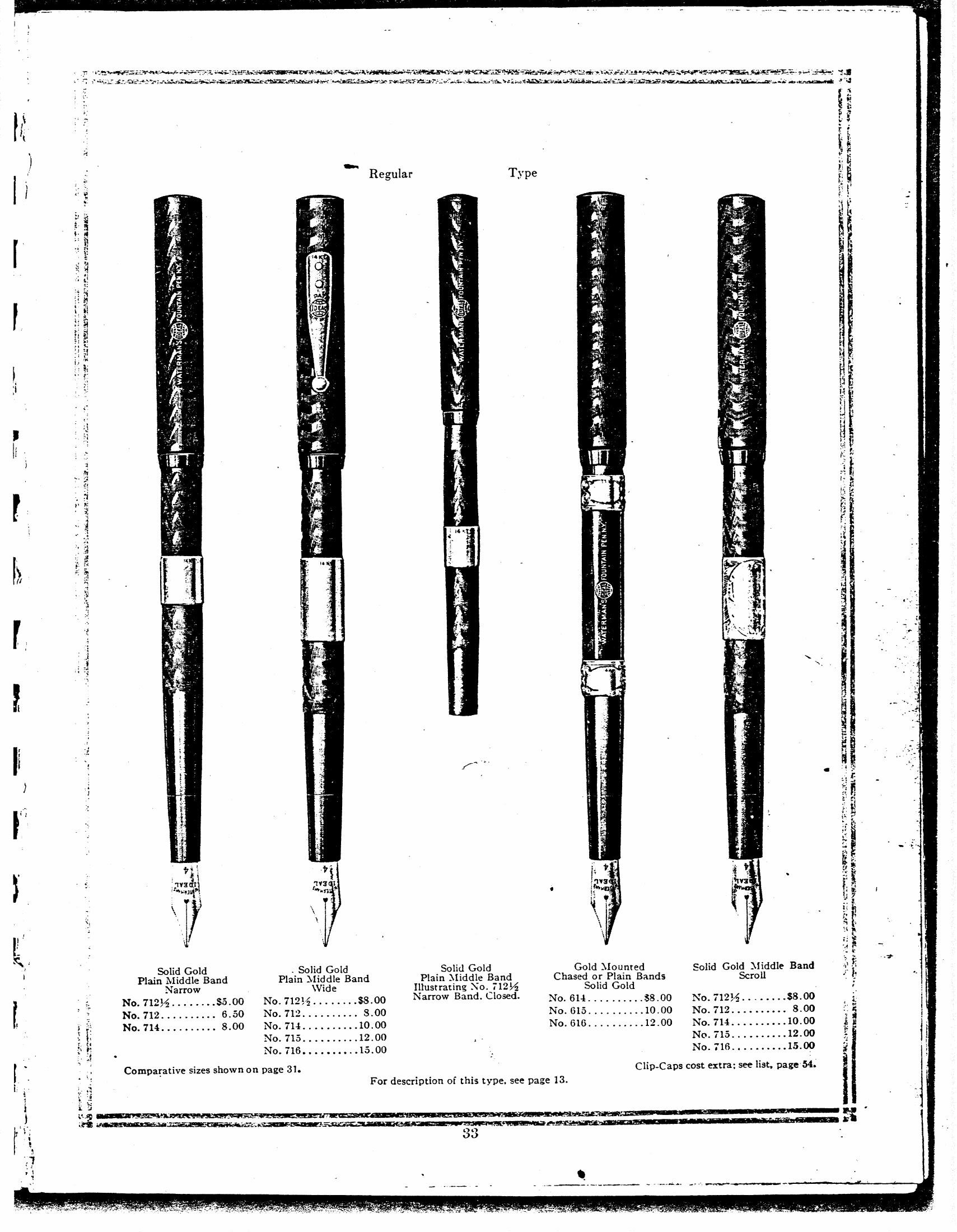
The 1919 Waterman catalog lists the following prices for Model 12 variants:4
- No. 12 plain or chased: $2.50
- No. 0712 (one gold middle band, engraved or plain): $3.50
- No. 0612 (two gold bands): $3.50
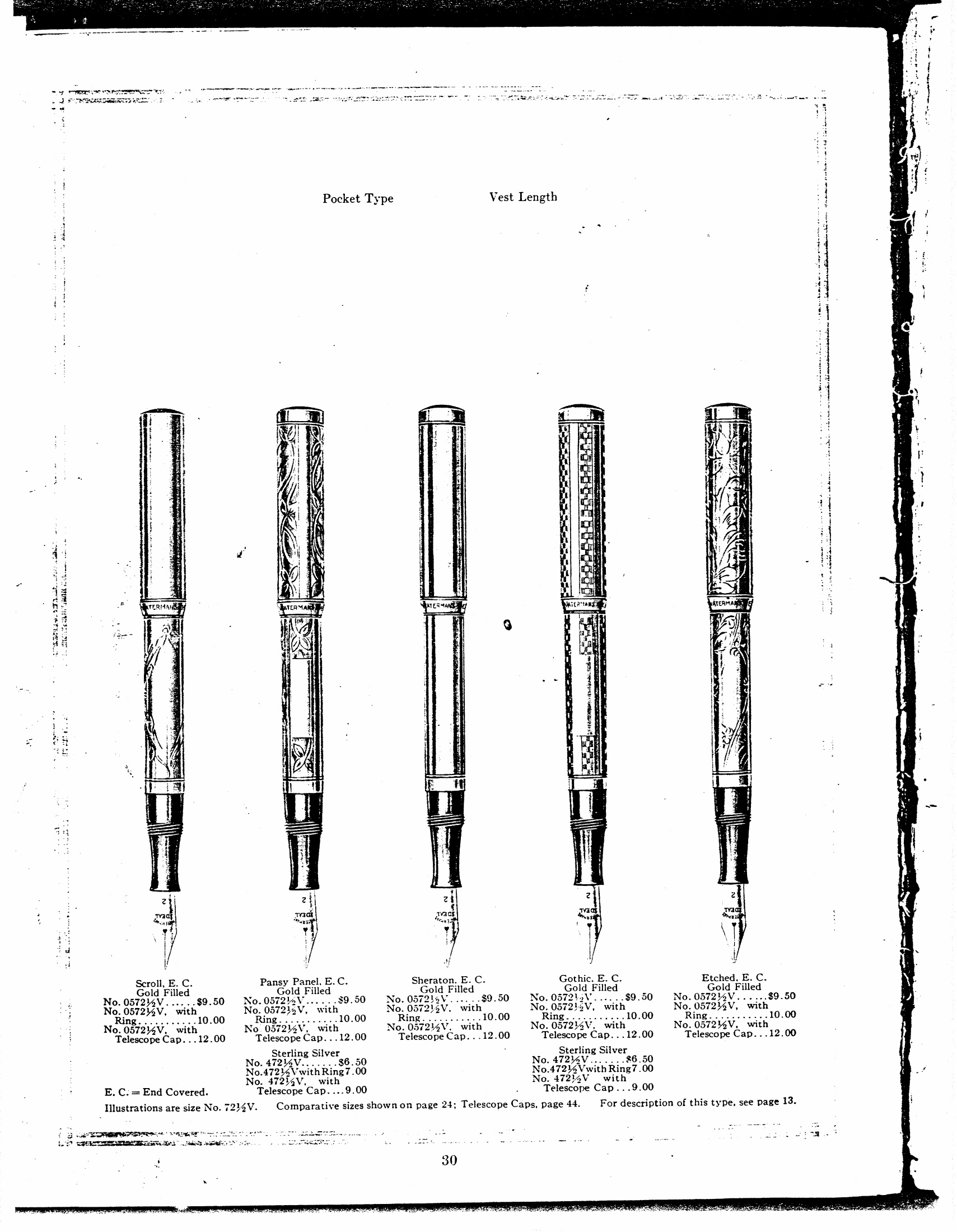
- Sterling silver overlays (Gothic, Filigree, Pansy Panel, Oriental patterns): $5.00-$7.50
- Solid gold overlay (512): $22.50+
The Numbering System
Waterman’s model numbering, standardized in fall 1908 and revised in spring 1917, encodes the pen’s features in its digits:5
- Units place = nib size (2 = #2 nib)
- Tens place = cap/filling type (1 = cone-cap eyedropper)
- Hundreds place = overlay material (05 = gold-filled full overlay, 4 = sterling full overlay, 5 = solid gold, 06 = two gold bands, 07 = one gold band, 08 = gold cap band, 09 = gold cap-top band)
So 0512, 412, and 512 are all the same Model 12 pen with different overlay metals: gold-filled, sterling silver, and solid gold respectively.5
Overlay Patterns
Overlay variants feature named patterns applied to the metal surface:6
- Trefoil Vine Filigree (1907-1923): Art Nouveau design, the most common filigree. Sterling, gold-filled, or solid gold.6
- Gothic: Geometric pattern found on 0512 and 412 variants.6
- Barleycorn: More popular in the UK than the USA.6
- Scroll, Chased, Basketweave/Bamboo (Art Deco, 1925+), Sheraton, Pansy Panel, Oriental: All documented in the overlay pattern reference.6
- Fine Silver Filigree (c. 1899-1903): The earliest overlays, made from .999 pure silver via electrodeposition with hand-cut piercings. Rare.6
Identification
Look for the barrel imprint: “L.E. Waterman Co.” or “Waterman’s Ideal.”7 The model number is typically stamped on the barrel end.5 Flexible nibs are common on early examples — test for flex by gently spreading the tines.1 Hard rubber should be black; brown oxidation indicates sun damage or age.7
-
David Nishimura, “Waterman Eyedroppers,” vintagepens.com. Link. ↩ ↩2 ↩3 ↩4 ↩5 ↩6
-
Thierry Nguyen, “Waterman’s first pens,” Fountain Pen History, November 2015. Link. ↩ ↩2 ↩3
-
Dirck de Lint, “Waterman,” Ravens March Fountain Pens. Link. ↩
-
Waterman’s Ideal Fountain Pen catalog, 1919, pp. 31-37 (Regular Type). Internet Archive. Link. ↩
-
David Nishimura, “Waterman Model Numbers,” vintagepens.com. Link. ↩ ↩2 ↩3
-
David Nishimura, “Waterman Overlay Patterns,” vintagepens.com. Link. ↩ ↩2 ↩3 ↩4 ↩5 ↩6
-
Peyton Street Pens, “Waterman Pen Model Identifier: Early Eyedroppers.” Link. ↩ ↩2